

You’ve found a home you love, your offer has been accepted, and your mortgage financing is coming together. You’re getting closer to possession day.
But before you start packing, there’s another financial consideration worth understanding: the closing costs of buying a home in Alberta.
Many buyers spend months saving for their down payment without realizing there are additional expenses involved in completing a purchase.
Legal fees, land title registration charges, property tax adjustments, insurance, and other costs can add up. Some need to be paid before closing, while others become part of the final amount your lawyer asks you to provide.
The good news? Most of these expenses can be anticipated and budgeted for.
At ARIVL, we believe buyers should understand the full financial picture before making an offer, not discover unexpected costs days before receiving their keys.
Let’s explore what closing costs you can expect when buying a home in Edmonton or elsewhere in Alberta, how they’re calculated, and how you can prepare.
1. What Are Closing Costs When Buying a Home?
Closing costs are the expenses associated with completing your property purchase, separate from the purchase price itself.
Some are required to legally transfer ownership or register your mortgage. Others depend on your financing, property type, or the terms of your purchase agreement.
It’s helpful to distinguish between three amounts:
- Your down payment: The money you’re contributing toward the property’s purchase price.
- Your deposit: Money paid according to your purchase agreement, generally credited toward the purchase price at closing.
- Your closing costs: Additional expenses associated with completing the transaction.
For example, if you’re buying a $400,000 home with a $20,000 down payment and have already paid a $10,000 deposit, that deposit will generally count toward your down payment.
You would typically still need to provide the remaining $10,000 of your down payment, plus applicable closing costs.
The exact amount required will be calculated by your lawyer, taking into account your mortgage proceeds, contractual terms, and adjustments.
ARIVL’s advice: Before making an offer, confirm how much cash you’ll need at each stage of the transaction, including your deposit, condition-period expenses, and final closing funds.
2. Legal Fees and Disbursements
In Alberta, a real estate lawyer plays an important role in completing your purchase.
Your lawyer coordinates the legal transfer of ownership, handles mortgage instructions, reviews relevant title matters, and prepares the documentation required to close.
What are you paying for?
Depending on the transaction, your legal expenses may include:
- Professional legal fees
- Title searches and related documents
- Preparing and reviewing transfer and mortgage documentation
- Coordinating funds with your lender
- Registration services
- Courier, administrative, and other disbursements
- Applicable GST on legal services and taxable disbursements
Law firms may quote their services differently. Some offer a package price, while others separate professional fees, disbursements, registration charges, and additional work.
How much do lawyers charge for a home purchase in Alberta?
For budgeting purposes, you might use an illustrative allowance of approximately $1,200 to $2,000 for routine legal services and associated disbursements, excluding substantial government registration charges.
However, this isn’t a fixed Alberta fee schedule or a quotation. Actual charges may fall outside that range depending on the law firm, mortgage requirements, number of titles, transaction complexity, and services included.
When comparing quotes, ask what’s included.
A lower advertised legal fee isn’t necessarily the lowest total cost.
ARIVL’s advice: Choose a lawyer experienced in Alberta residential real estate transactions and request a detailed estimate well before closing.
3. Alberta Land Title Registration Fees
One advantage Alberta buyers often hear about is that the province doesn’t charge a conventional land transfer tax like some other Canadian provinces.
That’s true, but it doesn’t mean transferring ownership is free.
Alberta charges registration fees when ownership is transferred and when a mortgage is registered against a property.
How are Alberta Land Title Registration Fees calculated?
Under Alberta’s published registration fee structure, the standard calculations are:
- Transfer of land: $50 plus $5 for every $5,000, or portion of $5,000, of the property’s value.
- Mortgage registration: $50 plus $5 for every $5,000, or portion of $5,000, of the registered mortgage principal.
These are separate registrations.
Additional charges may apply when a transaction involves multiple titles or other registered documents.
The Government of Alberta has published an updated fee schedule effective January 1, 2027. While the standard transfer and mortgage formulas remain unchanged, some other document registration fees are increasing.
Your lawyer will confirm the applicable charges based on the registration date and the documents involved.
Example: Buying a $400,000 home in Edmonton
Suppose you’re purchasing a $400,000 property and registering a $380,000 mortgage.
| Registration | Calculation | Fee |
|---|---|---|
| Transfer of land | $50 + (80 × $5) | $450 |
| Mortgage registration | $50 + (76 × $5) | $430 |
| Combined registration fees | $880 |
In this example, your standard land transfer and mortgage registration charges would total approximately $880.
This assumes one title, a $400,000 value for registration purposes, and a $380,000 registered mortgage principal.
It doesn’t include legal fees, title insurance, searches, additional titles, or other applicable registrations.
The amount secured by your registered mortgage may also differ from the amount you initially borrow.
Where can you find Alberta’s official land title fees?
The Government of Alberta provides information about property ownership, title transfers, registration requirements, and related services through its Alberta Land Titles website.
For a detailed breakdown of registration charges, you can also review the official Land Titles and Surveys Common Documents Fee Schedule.
These resources are helpful when estimating your closing costs, although your real estate lawyer will confirm the applicable fees based on your specific transaction.
ARIVL’s advice: Don’t confuse Alberta’s lack of a traditional land transfer tax with having no registration expenses. These charges should be included in your purchase budget, particularly when buying higher-priced properties or properties with multiple titles.
4. Property Tax Adjustments at Closing
Property tax adjustments are one of the most commonly misunderstood closing expenses.
In Edmonton, property taxes are generally calculated for the calendar year, but ownership can change partway through that period.
The closing process accounts for which party is responsible for the relevant portion of the year’s property taxes.
What happens if the seller has already paid the taxes?
Imagine purchasing a home with annual property taxes of $3,600.
If the seller has already paid the full year’s taxes and possession occurs at the beginning of September, the buyer may need to reimburse the seller for the remaining four months.
For a simplified example:
- Annual property taxes: $3,600
- Approximate monthly amount: $300
- September through December: Four months
- Illustrative reimbursement: $1,200
This amount would increase the buyer’s closing funds.
The actual adjustment is calculated according to the purchase agreement, relevant dates, and payment information.
What if the seller hasn’t paid the taxes?
Depending on the circumstances, the seller may instead provide a credit to the buyer for the seller’s share of unpaid taxes.
That could reduce the amount the buyer needs to provide at closing.
An adjustment isn’t necessarily a new tax or additional fee. It’s an allocation of an existing property expense between the buyer and seller.
For a more detailed explanation, read our guide to how property taxes, utilities, and fees are adjusted at closing.
ARIVL’s advice: Ask your lawyer to explain your property tax adjustment before signing your closing documents. Depending on the circumstances, it can increase or decrease the funds required to complete your purchase.
5. Home Inspection and Property Due Diligence Costs
A home inspection is typically completed during the conditional period, before your purchase becomes unconditional.
Although inspection expenses aren’t usually paid through your lawyer at closing, they’re still important upfront costs to include in your buying budget.
What might you need to pay for?
Depending on the property, you may consider:
- General home inspection
- Sewer line inspection
- Roofing or mechanical system assessment
- Structural engineering consultation
- Environmental or specialized testing
- Additional contractor assessments
Not every purchase requires all these services.
A general inspection may be sufficient for some properties, while others warrant further investigation.
How much does a home inspection cost?
Inspection prices depend on property size, age, type, location, and the scope of services.
For a basic planning example, you might reserve approximately $500 to $700 for a general home inspection, then confirm the actual fee with your chosen inspector.
Specialized inspections may cost more.
What if you don’t proceed with the purchase?
In most cases, you’ll still be responsible for the professional services you’ve ordered and received, even if you ultimately decide not to complete the purchase.
That makes inspection and due diligence costs an important part of your financial planning.
ARIVL’s advice: Don’t skip important due diligence simply to save money upfront. Understanding a property’s condition can help you make a more informed purchase decision.
6. Mortgage Appraisal and Financing Costs
Your mortgage lender may require an appraisal before approving financing for a particular property.
An appraisal provides an independent opinion of value for lending purposes.
It’s different from a home inspection and doesn’t replace one.
Who pays for the appraisal?
That depends on your lender, mortgage product, and financing arrangement.
Some lenders cover the appraisal cost. Others may require the buyer to pay.
Additional expenses can arise if the transaction requires specialized financing, private lending, or other non-standard mortgage arrangements.
What about mortgage default insurance?
If you’re purchasing with less than 20% down, you may require mortgage default insurance.
For eligible mortgages, the insurance premium is often added to the mortgage principal rather than paid separately in cash at closing.
However, adding the premium increases the amount borrowed and the interest paid over time.
Mortgage default insurance isn’t the same as home insurance or optional mortgage life and disability insurance.
Your mortgage professional should explain the costs and financing requirements that apply to your purchase.
ARIVL’s advice: Ask your mortgage professional for a clear breakdown of upfront financing costs, lender fees, and any premiums being added to your mortgage.
7. Title Insurance and Other Legal Protections
Title insurance is another expense buyers may encounter.
Depending on the policy, title insurance can provide protection against certain covered title-related risks, subject to its terms, exclusions, and limitations.
Is title insurance required?
Not every purchase has identical requirements.
Your lender may require a lender’s title insurance policy, and your lawyer may recommend an owner’s policy depending on the transaction.
These policies protect different interests, so it’s important to understand what you’re purchasing.
Title insurance isn’t a substitute for reviewing property condition, zoning, permits, or other due diligence matters.
What about a Real Property Report?
For certain residential purchases, a Real Property Report (RPR) and evidence of municipal compliance may be relevant under the purchase contract.
An RPR provides survey information about the property and visible improvements, while municipal compliance concerns the municipality’s review of applicable matters.
The seller’s obligations depend on the contract, and title insurance doesn’t automatically eliminate concerns related to an RPR.
Your REALTOR® and lawyer should explain what’s required for your particular transaction.
ARIVL’s advice: Ask your lawyer what title insurance covers, whether it’s required by your lender, and whether any survey or compliance concerns deserve attention before closing.
8. Closing Costs When Buying a Condominium
If you’re buying a condominium in Edmonton, there may be additional expenses beyond those associated with a typical detached property purchase.
Condominium document review
Before proceeding with a condominium purchase, buyers should carefully review the corporation’s documents.
These may include financial statements, budgets, reserve fund studies, meeting minutes, bylaws, insurance documents, and other relevant information.
You may choose to hire a condominium document review professional.
Document acquisition and review services can involve additional fees.
Condominium fee adjustments
If the seller has prepaid condominium contributions that cover a period after possession, an adjustment may be required.
The amount depends on the monthly contribution, payment schedule, possession date, and contract terms.
Move-in and administration fees
Some condominium corporations charge move-in fees, elevator booking deposits, access-device charges, or other administrative fees.
Others may have restrictions on when moves can occur.
Review the corporation’s bylaws, policies, and relevant documents so you know what arrangements and costs may apply.
Special assessments
A special assessment can create a substantial financial obligation for condominium owners.
Who is responsible for a particular assessment during a sale depends on the relevant contractual provisions and circumstances.
Don’t assume all assessments are automatically paid by the seller or that every future assessment is the buyer’s responsibility.
ARIVL’s advice: When buying a condominium, your financial due diligence should include the corporation as well as the unit. A relatively affordable purchase price doesn’t tell you everything about the property’s financial risks.
9. GST and Closing Costs on Newly Built Homes
Buying a newly constructed home can involve different financial considerations from purchasing an ordinary resale property.
Most previously occupied residential resale sales are GST-exempt, while qualifying new residential construction is generally subject to GST.
In Alberta, the federal GST rate is 5%.
Is GST included in the advertised price?
That depends on the builder’s pricing and purchase agreement.
Some advertised prices include GST and assume an eligible rebate will be assigned to the builder. Other agreements may present the calculation differently.
Before signing, confirm:
- Whether the purchase price includes GST
- Which GST rebates are included or assumed
- Whether you’re eligible for the relevant rebate
- Whether the rebate must be assigned to the builder
- What happens if your eligibility changes
- Which construction features and upgrades are included
What about the first-time buyer GST rebate?
Eligible first-time buyers may qualify for a federal GST rebate on certain newly built or substantially renovated homes.
The rebate can provide significant savings, subject to property values, eligibility criteria, purchase dates, and other requirements.
We’ve explained these programs in more detail in our First-Time Home Buyer Programs and Incentives in Alberta guide.
Other potential new construction expenses
Depending on the builder and property, you may also need to budget for landscaping, fencing, appliances, window coverings, unfinished basements, or other items not included in the purchase price.
Review the builder agreement carefully to understand what you’re receiving.
ARIVL’s advice: Compare the total cost of a new home, not just its advertised price. GST treatment, rebates, included features, and additional improvements can substantially affect your budget.
10. Moving, Insurance and Immediate Ownership Expenses
Some costs don’t appear on your lawyer’s final statement but still affect how much money you’ll need around possession day.
These may include:
- Moving company or truck rental
- Home insurance premiums
- Utility deposits or account setup charges, where applicable
- Mail forwarding
- Locks or security updates
- Furniture and appliances
- Cleaning and minor repairs
- Immediate maintenance needs
When should you arrange insurance?
Work with your insurance provider and mortgage lender to confirm when coverage must begin.
Your lender may require proof of acceptable insurance before advancing mortgage funds.
Condominium buyers should also consider personal condominium insurance, as the corporation’s policy doesn’t necessarily cover their belongings, improvements, or personal liability.
Keep a little money available after possession
It’s tempting to use your entire savings balance for your down payment and closing expenses.
However, having a financial cushion after moving in can help you manage unexpected repairs, purchases, or changes in household expenses.
ARIVL’s advice: Budget beyond the moment you receive your keys. Moving into a home is the beginning of ownership expenses, not the end.
11. Example: Closing Costs on a $400,000 Home in Edmonton
Let’s bring everything together with a practical example.
Imagine you’re purchasing a $400,000 resale home in Edmonton with a 5% down payment and a $380,000 mortgage before any mortgage default insurance premium.
The following figures are illustrative planning assumptions rather than quotes for a specific property.
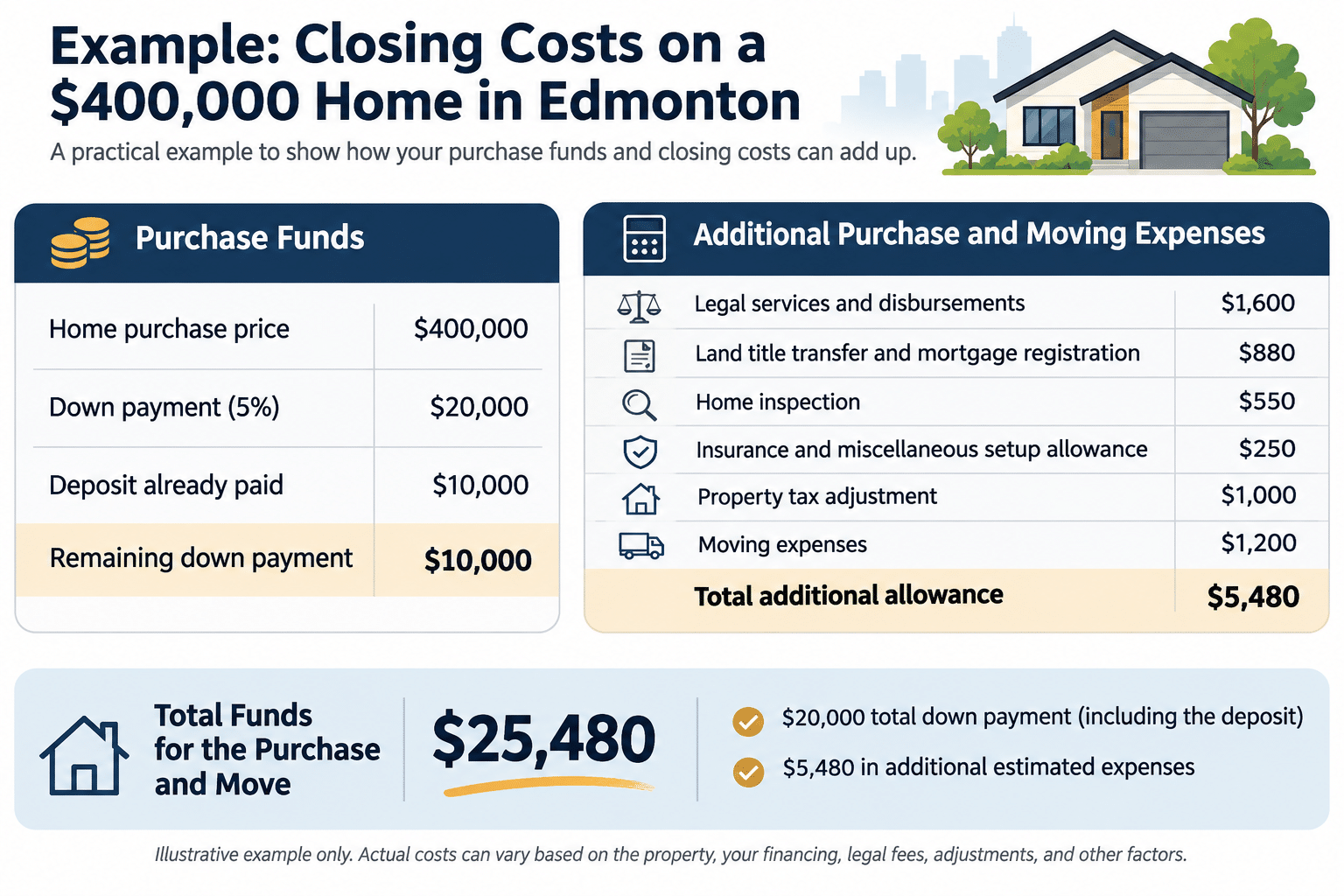
In this example, you would need:
- $20,000 total down payment, including the deposit
- $5,480 in additional estimated expenses
- $25,480 in combined funds for the purchase and move
Of that amount, $10,000 has already been paid as the deposit.
The amount required by your lawyer would differ from the full $25,480 because some expenses, such as your home inspection and moving costs, may be paid separately.
Your lender’s final mortgage instructions and any applicable mortgage insurance premium would also affect the closing calculations.
The example excludes optional specialist inspections, condominium-related costs, new construction GST, significant repairs, and additional financial reserves.
The property tax adjustment is also hypothetical. A real transaction might produce a smaller adjustment, a larger one, or a credit in the buyer’s favour.
ARIVL’s advice: Use an estimate like this to start planning, then replace the assumptions with actual figures from your lender, lawyer, inspector, and the property you’re purchasing.
12. When Do You Actually Pay Closing Costs?
Not every expense is due at the same time.
Understanding the timing can help you plan your cash flow.
| Stage | Common Expenses |
|---|---|
| Before making an offer | Mortgage preparation and optional professional advice |
| After offer acceptance | Contractual deposit and inspection or review costs |
| During due diligence | Appraisals or specialized assessments, where applicable |
| Before closing | Remaining down payment, legal fees, registration charges and adjustments |
| At or after possession | Moving, utilities, furnishings and immediate maintenance |
Your lawyer will advise when your closing funds are due, often before the scheduled completion date.
Keep the required money accessible and verify how your lawyer needs the funds delivered.
An important security reminder: Never change payment instructions based solely on an unexpected email. If you receive new banking or payment directions, independently verify them using a trusted telephone number for your law firm.
13. How Can You Avoid Surprises Before Closing?
A little preparation can make closing much easier.
Before making an offer, consider asking:
- How much will my deposit be, and when must I provide it?
- What are my estimated legal fees and land title charges?
- Will my lender require an appraisal or additional fees?
- What property tax or condominium fee adjustments might apply?
- Are there additional expenses related to the property’s ownership structure?
- If the home is newly built, how does GST affect my purchase?
- How much cash should I keep available after possession?
Your REALTOR®, mortgage professional, and lawyer each have a role in helping you answer these questions.
At ARIVL, our goal is to help you understand the process early, identify costs worth investigating, and connect with qualified professionals when specialized advice is needed.
Frequently Asked Questions About Closing Costs in Alberta
How much are closing costs on a $400,000 home in Alberta?
Closing costs vary depending on the property, financing, legal services, adjustments, and other circumstances.
For example, the standard transfer and mortgage registration fees for a $400,000 purchase with a $380,000 registered mortgage total approximately $880 under Alberta’s published fee structure.
Legal fees, inspections, insurance, tax adjustments, and other expenses are additional.
Does Alberta have a land transfer tax?
Alberta doesn’t impose a conventional provincial land transfer tax.
However, buyers still pay applicable land title transfer registration charges and, when relevant, mortgage registration charges.
Are closing costs included in my mortgage?
Not automatically.
Most buyers need accessible cash for the down payment and closing expenses.
Certain eligible costs, such as mortgage default insurance premiums, may be added to a mortgage, but that doesn’t mean all closing expenses can be financed.
Discuss your options with your mortgage professional.
Is my deposit part of my down payment?
Generally, yes.
The deposit is typically credited toward the purchase price when the transaction closes.
For example, if your total down payment is $20,000 and you’ve already provided a $10,000 deposit, the remaining down payment would generally be $10,000, subject to the full closing calculation.
Who pays the legal fees when buying a home in Alberta?
Typically, each party is responsible for their own legal representation, subject to any different agreement.
The buyer generally pays their lawyer for purchase-related services and applicable expenses.
Who pays property taxes on possession day?
Property taxes are generally allocated between the buyer and seller through the closing adjustment process, according to the contract and relevant dates.
Your lawyer will calculate the actual adjustment for your transaction.
Do first-time home buyers get a closing-cost rebate in Alberta?
There isn’t a general Alberta provincial closing-cost rebate automatically available to every first-time buyer.
However, eligible buyers may benefit from federal programs, tax credits, and GST rebates depending on the purchase and their circumstances.
Read our First-Time Home Buyer Programs and Incentives in Alberta guide for more information.
Planning Your Home Purchase? Know the Full Cost Before You Commit.
Understanding your closing costs is an important part of preparing to buy a home.
From legal expenses and land title registration to property tax adjustments and moving costs, knowing what to expect can help you budget confidently and avoid unnecessary surprises.
If you’re still exploring your finances, our guide to How Much Money You Really Need to Buy a Home in Edmonton is a helpful place to start.
For a complete walkthrough of the buying process, explore our Complete Guide to Buying a Home in Edmonton, Alberta.
At ARIVL, we help buyers understand the market, navigate important decisions, and prepare for each stage of purchasing a property.
When you’re ready, discover the ARIVL home-buying experience, email hq@arivl.ca, or contact Jakie at 780-224-5566.
ARIVL: Your Real Estate Adventure Awaits!
Last reviewed: November 27, 2026. Financial examples are illustrative. Government fees, tax rules, professional service charges, and lender requirements may change. Confirm costs specific to your purchase with your lawyer, mortgage professional, and applicable service providers.