
Buying your first home in Edmonton is exciting, but before you start browsing listings or imagining where your furniture will go, there’s one important question worth answering:
Can you actually afford to buy a home, and what would owning one mean for your everyday finances?
It’s a question we hear from many first-time buyers, and the answer involves more than having enough money saved for a down payment.
Between mortgage payments, property taxes, utilities, insurance, and unexpected repairs, homeownership comes with financial responsibilities that aren’t always obvious when you’re scrolling through listings.
The good news? With a realistic budget and a little preparation, you can make informed decisions about what you can afford without sacrificing everything else you enjoy.
At ARIVL, we believe the goal isn’t simply to qualify for the most expensive home possible. It’s to find a home that makes financial sense for you.
Let’s break down what you should consider before buying a home in Edmonton.
1. Start With What You Can Comfortably Afford
Before looking at purchase prices, take a closer look at your existing monthly expenses.
How much money comes into your household each month? How much goes toward transportation, groceries, debt payments, savings, travel, and the things you enjoy?
Buying a home will change your budget, but it shouldn’t mean giving up everything that makes your life enjoyable.
Your mortgage approval isn’t your personal budget
Mortgage lenders assess affordability using your income, existing debts, credit history, and other financial information.
They commonly evaluate two debt-service ratios:
- Gross Debt Service (GDS): The portion of your gross income required for qualifying housing expenses, such as mortgage payments, property taxes, heating, and applicable condominium fees.
- Total Debt Service (TDS): A broader calculation that includes qualifying housing expenses and other debt obligations.
For many mortgage applications, commonly used qualification guidelines are approximately 39% for GDS and 44% for TDS, although specific lender and mortgage insurance requirements can differ.
These calculations help lenders assess whether you qualify for financing, but they don’t necessarily reflect your personal spending habits or financial priorities.
You may qualify for a mortgage that leaves you with less money than you’d like for savings, travel, hobbies, or future plans.
Build your budget around your lifestyle
Start by identifying the monthly housing expense you’re comfortable carrying.
Include:
- Mortgage payment
- Property taxes
- Home insurance
- Utilities
- Condominium fees, where applicable
- Maintenance and repair savings
Then consider what’s left for your other expenses and financial goals.
ARIVL’s advice: Don’t start with the maximum mortgage your lender will approve. Start with the monthly payment and overall lifestyle you’re comfortable maintaining, then work backward to determine a suitable purchase price.
2. How Much Down Payment Do You Need in Edmonton?
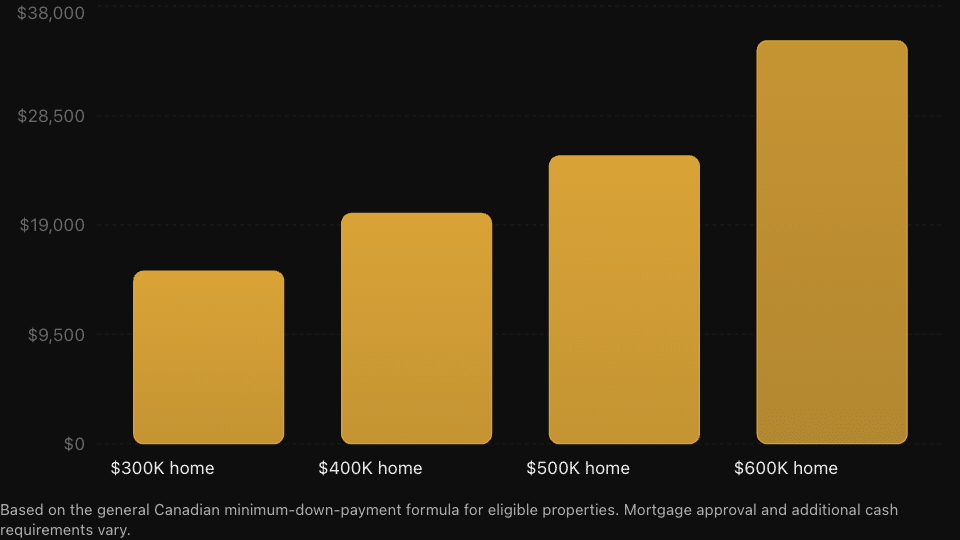
Your down payment is the money you contribute toward the purchase price of your home.
The minimum amount generally depends on the purchase price and your mortgage eligibility.
Canada’s minimum down payment requirements
For eligible home purchases, the general rules are:
| Purchase Price | Minimum Down Payment |
|---|---|
| $250,000 | $12,500 |
| $300,000 | $15,000 |
| $400,000 | $20,000 |
| $500,000 | $25,000 |
| $600,000 | $35,000 |
| $700,000 | $45,000 |
For homes priced at $500,000 or less, the general minimum is 5%.
For homes priced above $500,000 but below $1.5 million, the minimum is calculated as 5% of the first $500,000, plus 10% of the remaining purchase price.
For homes priced at $1.5 million or more, the general minimum is 20%.
These are minimum down payment amounts, not guarantees of mortgage approval. Your lender may require a larger down payment depending on your circumstances.
What happens if you put less than 20% down?
If your down payment is less than 20%, you’ll generally need mortgage default insurance, assuming the purchase and financing qualify.
This insurance protects the lender if you default on your mortgage. It doesn’t protect you from missed payments or financial hardship.
The insurance premium is often added to your mortgage balance, which increases the amount you borrow and the interest you pay over time.
A larger down payment can reduce your mortgage balance and may also lower or eliminate mortgage default insurance costs.
However, there’s another consideration: using every dollar of your savings for your down payment could leave you without enough money for closing expenses or emergencies.
ARIVL’s advice: A bigger down payment can be beneficial, but not if it leaves you financially unprepared after possession.
For current requirements, visit the Government of Canada’s down payment guide.
3. Don’t Forget the Upfront Costs of Buying a Home
One of the biggest surprises for first-time buyers is discovering that the down payment isn’t the only money they’ll need.
There are several expenses to consider before and during the purchase.
Common upfront buying expenses
Home inspection: A professional inspection can provide valuable information about a property’s visible condition and potential repair needs.
Property appraisal: Your lender may require an appraisal to evaluate the property for mortgage purposes. Depending on the financing arrangement, you may be responsible for the cost.
Legal fees and disbursements: Your real estate lawyer handles legal documentation, closing arrangements, and other aspects of transferring ownership.
Land title registration charges: Alberta doesn’t have a conventional provincial land transfer tax, but applicable registration charges still apply when transferring title and registering a mortgage.
Title insurance: Depending on the transaction, your lawyer or lender may recommend or require title insurance.
Property tax and condominium fee adjustments: You may need to reimburse the seller for certain prepaid expenses that relate to your period of ownership.
Moving costs: Professional movers, transportation, utility setup, furniture, and household essentials can add up.
For newly constructed homes, GST treatment, applicable rebates, and additional builder-related expenses also deserve attention.
What about your deposit?
In Alberta, a deposit is commonly negotiated as part of your purchase offer.
The amount and payment deadline are established in the purchase contract.
The deposit is generally credited toward the purchase price on closing, meaning it isn’t normally an additional expense on top of the agreed purchase price.
However, you’ll need access to the deposit funds when they’re due, which may be well before your lawyer requires the remainder of your down payment.
The deposit’s treatment if a transaction doesn’t proceed depends on the contract and circumstances.
How much should you budget for closing costs?
The amount varies depending on your purchase price, lender requirements, legal expenses, property type, and transaction details.
A useful starting point is to set aside additional savings beyond your down payment and request estimates from your mortgage professional and lawyer early in the process.
For illustration, someone purchasing a $400,000 resale home might choose to reserve an additional $6,000 to $10,000 for upfront costs, moving, and initial expenses.
That’s a planning allowance, not a quotation or a mandatory amount. Your actual costs could be lower or higher, particularly when buying a condominium, newly built property, or a home requiring additional professional assessments.
Want a more detailed breakdown of the expenses beyond your down payment? Our guide to closing costs when buying a home in Alberta explains legal expenses, land title registration charges, property tax adjustments, and other costs, with a practical Edmonton purchase example.
ARIVL’s advice: Calculate the down payment, deposit timing, and closing expenses together. You want to know how much cash you’ll need throughout the purchase, not just on possession day.
4. What Does a $400,000 Home Actually Cost Each Month?
Let’s use an example to understand why your monthly budget matters just as much as the purchase price.
Imagine you’re buying a $400,000 resale home in Edmonton with a 5% down payment.
Example purchase assumptions
| Item | Amount |
|---|---|
| Purchase price | $400,000 |
| Down payment (5%) | $20,000 |
| Mortgage before insurance | $380,000 |
| Illustrative mortgage insurance premium (4%) | $15,200 |
| Total mortgage including premium | $395,200 |
For this example, assume a fixed interest rate of 4%, a 25-year amortization period, and monthly payments.
Your estimated principal-and-interest mortgage payment would be approximately $2,086 per month.
This is a mathematical illustration, not a current mortgage rate quote, and it assumes the specified mortgage insurance premium is added to the loan.
But your mortgage payment is only the beginning.
Example monthly ownership budget
| Monthly Expense | Illustrative Amount |
|---|---|
| Mortgage payment | $2,086 |
| Property taxes | $300 |
| Home insurance | $125 |
| Utilities | $350 |
| Maintenance savings | $250 |
| Estimated total | $3,111 |
These are hypothetical planning assumptions, not verified expenses for a particular Edmonton property. Actual property taxes, utilities, insurance, maintenance, and financing costs may differ significantly.
The example also doesn’t include any condominium fees or additional household expenses.
Now imagine your current rent is $1,800 per month.
Moving into this example home could mean allocating substantially more of your monthly income toward housing.
That doesn’t necessarily make buying a bad decision. Part of your mortgage payment reduces your principal balance, while renting doesn’t build ownership equity in the same way.
But principal repayment doesn’t eliminate the need to manage your monthly cash flow.
You still need enough income to pay your bills, save for future expenses, and enjoy your life.
ARIVL’s advice: Compare the complete cost of owning a home against your current housing expenses. The purchase price alone won’t tell you whether the home fits your budget.
5. Get Mortgage Pre-Approval Before You Start Shopping
Mortgage pre-approval is an important step because it helps establish a realistic price range and identifies financing considerations early.
During the process, your mortgage professional may review your:
- Income and employment
- Credit history
- Existing debts
- Down payment funds
- Financial assets and liabilities
- Intended property purchase and mortgage requirements
They can also explain interest-rate options, mortgage terms, payment schedules, and potential penalties.
Does pre-approval guarantee your mortgage?
No.
A pre-approval is a preliminary assessment based on your financial circumstances and the information available at the time.
The lender will still need to review the property you’re buying and confirm that all financing requirements are satisfied.
For example, your lender may require a property appraisal or additional documentation before giving final approval.
Some lenders offer temporary interest-rate holds during pre-approval, but the availability, duration, and conditions vary.
Why does this matter when making an offer?
If you’re considering a purchase, you’ll want to understand whether a financing condition is appropriate for your circumstances.
An accepted offer doesn’t automatically mean your lender has approved the specific property.
Your REALTOR® and mortgage professional should help you understand the timeline and outstanding financing requirements before you decide whether to proceed unconditionally.
For more insight, read our related article, Why Isn’t Your Mortgage Pre-Approval Always What You Expect?, in ARIVL’s Mortgages & Financing category.
ARIVL’s advice: Speak with a mortgage professional before you become emotionally attached to a property. Understanding your financing early gives you more confidence and time to address potential issues.
6. Build a Financial Cushion for the Unexpected
Homeownership comes with responsibilities that aren’t always predictable.
A furnace can stop working, an appliance can fail, or an unexpected repair can become necessary.
Interest rates and household circumstances can also change over time.
That’s why having an emergency fund is so important.
How much should you save?
A commonly recommended starting goal is three to six months of essential living expenses.
The appropriate amount depends on your financial stability, employment situation, dependants, property condition, and personal comfort with risk.
If you have variable income or you’re buying an older home with significant maintenance needs, you may prefer a larger reserve.
What about home maintenance?
Some homeowners use 1% of their property’s value annually as a rough starting point for a maintenance allowance.
For a $400,000 property, that would be $4,000 annually.
However, this isn’t a universal requirement or a prediction of what your home will actually cost to maintain.
Maintenance needs vary based on the age and condition of the building, its systems, previous renovations, and your ownership responsibilities.
A newly built property may have different near-term maintenance needs from a 60-year-old home.
Similarly, condominium owners may pay for certain maintenance through their monthly fees, but can still face personal repair expenses and special assessments.
ARIVL’s advice: Don’t use all your savings to complete the purchase. Having money available after possession can make the transition to homeownership much less stressful.
7. Explore First-Time Home Buyer Savings Programs
If you’re buying your first home, you may have access to programs that help you save or use existing savings more effectively.
Two important federal options are the First Home Savings Account and the Home Buyers’ Plan.
First Home Savings Account (FHSA)
The FHSA allows eligible first-time buyers to save toward a qualifying home purchase with tax advantages.
The general annual contribution limit is $8,000, with a lifetime contribution limit of $40,000.
Contributions may be tax-deductible, and qualifying withdrawals can be tax-free.
Eligibility, contribution room, and withdrawal rules apply.
Learn more through the Canada Revenue Agency’s FHSA guide.
Home Buyers’ Plan (HBP)
The Home Buyers’ Plan allows eligible buyers to withdraw up to $60,000 from their RRSPs toward a qualifying home purchase, subject to program requirements.
Unlike qualifying FHSA withdrawals, HBP withdrawals generally come with repayment obligations under the applicable rules.
In some circumstances, eligible buyers may use both programs together.
You can review the CRA’s Home Buyers’ Plan information.
There may also be additional federal tax credits or rebates depending on your eligibility and the type of home you’re purchasing.
Because program rules and benefits can change, consult the official sources and a qualified tax or financial professional before relying on a particular benefit.
ARIVL’s advice: Explore your options before moving money between accounts or making a purchase. The right savings strategy can make a meaningful difference in how prepared you are.
8. Think Beyond the Numbers
This may be the most important part of the entire conversation.
Buying a home isn’t just a mathematical exercise. It’s a lifestyle decision.
Before committing to a purchase, ask yourself:
- Will I still have room in my budget for travel, hobbies, and things I enjoy?
- Can I continue saving for retirement and other financial goals?
- Would an unexpected repair put me in a difficult financial position?
- Am I comfortable with the responsibilities of maintaining this property?
- Does this home suit my needs for the next several years?
- Am I buying because I’m ready, or because I feel pressured?
There’s no universal answer to these questions.
Some buyers are comfortable dedicating a larger portion of their income to housing. Others prefer greater financial flexibility.
Neither approach is necessarily wrong.
What matters is understanding the trade-offs and making a decision that suits your circumstances.
What if you’re not quite ready?
That’s perfectly reasonable.
Perhaps you need more time to build your savings, reduce debt, strengthen your credit, or improve your understanding of the market.
You can still begin exploring neighbourhoods, learning about property types, and preparing for a future purchase.
At ARIVL, we’re happy to help buyers develop a plan even if their intended purchase is several months or longer away.
Our advice: The best time to buy isn’t necessarily when you can qualify for a mortgage. It’s when you’re financially prepared and comfortable with the commitment you’re making.
Frequently Asked Questions About Affording a Home in Edmonton
How much money do I need saved to buy a $400,000 home in Edmonton?
For an eligible purchase, the general minimum down payment is $20,000.
You’ll also need additional funds for closing expenses, and you should consider keeping emergency savings available after the purchase.
Your total cash requirement will depend on your financing, property type, and other expenses.
Can I buy a home in Alberta with no down payment?
Most conventional home-purchase financing requires a down payment.
Some specialized arrangements may exist, but buyers should be cautious about financing strategies that rely on additional borrowing or create greater financial risk.
Speak with a qualified mortgage professional about your eligibility and options.
Is it cheaper to buy a condominium than a house in Edmonton?
Not necessarily.
Condominiums can have lower purchase prices than detached homes, but condominium fees, special assessments, insurance, and maintenance responsibilities need to be considered.
Compare the total cost of ownership rather than purchase prices alone.
Should I put 5% or 20% down?
That depends on your available savings, financing eligibility, mortgage costs, and personal financial goals.
A larger down payment generally reduces the amount you need to borrow and may eliminate mortgage default insurance requirements.
However, keeping sufficient savings for emergencies and other expenses is also important.
What salary do I need to buy a home in Edmonton?
There isn’t one income requirement that applies to every buyer.
Mortgage approval depends on your income, debts, down payment, interest rates, creditworthiness, property expenses, and lender requirements.
A mortgage professional can help estimate your qualifying purchase range, while a household budget can help determine what feels comfortable.
Should I get pre-approved before contacting a REALTOR®?
Mortgage pre-approval is strongly recommended before actively shopping, but you don’t need to complete it before speaking with ARIVL.
We’re happy to discuss the buying process, help you establish priorities, and connect you with mortgage professionals who can assess your financing options.
Ready to Find Out What You Can Comfortably Afford?
Buying a home should feel like a meaningful step forward, not an overwhelming financial obligation.
At ARIVL, we help Edmonton buyers understand their options, explore suitable properties, and make confident decisions based on their goals and circumstances.
Whether you’re ready to purchase now or simply want to understand what homeownership could look like for you, we’re here to help you develop a plan.
Understanding your budget is an important first step, but there’s more to buying a home than getting your finances in order. From choosing the right property and making an offer to navigating conditions and preparing for possession, knowing what to expect can make the entire experience feel more manageable.
For a complete walkthrough, explore our Complete Guide to Buying a Home in Edmonton, Alberta, where we break down the entire process into 10 practical steps to help you buy with confidence.
When you’re ready to take the next step, discover the ARIVL home-buying experience, email hq@arivl.ca, or contact Jakie at 780-224-5566.
ARIVL: Your Real Estate Adventure Awaits!